






A thick, sour stench of rotting soda and chemical waste hangs over a secluded compound in Osogbo, the Osun State capital, warning of a problem before it is seen.
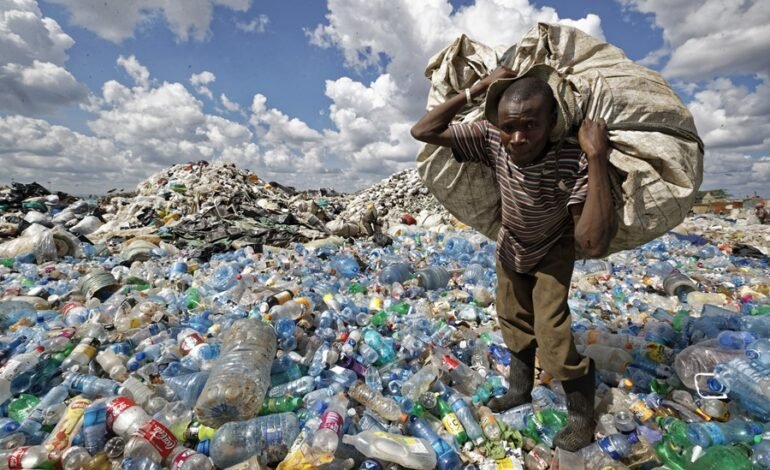
Behind a rusted fence, a mountain of plastic bottles rises nearly two storeys high, gathered from gutters and dumps across five local government areas. At its base, stagnant water festers, alive with mosquitoes.
This is “Alhaji’s collection point”, a well-intentioned but hazardous hub in Nigeria’s booming informal recycling chain, where efforts to clean up plastic waste are fuelling new environmental and public health risks.
Grassroots collection, hidden harm
Mr Musa, who runs the site, sees himself as an environmentalist. “Every bottle here is one less bottle blocking our gutters in Osogbo or polluting our rivers,” he said.
Related Posts:
- FULL TEXT: Dapo Olorunyomi’s lecture at Ajayi Crowther University on Nigerian journalism
- SPECIAL REPORT: Failing waste system leaves Lagos roads buried in trash
- Unsafe, Unprotected: Oyo schoolgirls suffer in silence over lack of menstrual facilities
- In Nigeria’s northern state, female scientist mobilises women climate warriors
He buys bottles from a network of pickers at N200 per kilogramme, then bales and sells them further up the value chain.
While he acknowledges the smell and mosquitoes, he asks, “How can saving plastic be bad?”
Yet, scenes like this are replicated across Nigeria, revealing a growing national paradox. Plastic collection has become a vital source of income, championed by communities and corporations alike.
However, a widening disconnect exists between the act of collection and the harmful lifecycle that follows. What is meant to be a solution is increasingly becoming a source of sickness.
When good intentions turn hazardous
The danger begins at the point of storage. Bottles retrieved from dumps and drains often contain residues of sugary drinks, palm wine, or oil. When piled in unlined sites, these residues leach out, forming a toxic slurry that seeps into the soil and groundwater.
Studies on waste disposal in Nigeria show that such leachate frequently contains heavy metals and chemicals that exceed World Health Organisation (WHO) standards, posing serious risks to both surface and groundwater.
In Osogbo’s Igbonna area, a tailor, Ronke Adeyemi, complained of unbearable stench and a surge in mosquitoes.
“We spend more on malaria drugs now than before this ‘recycling business’ started,” she said.
A community health officer in Olorunda LGA, who asked not to be named, confirms a rise in malaria, respiratory problems, and skin rashes in communities near storage sites.
“The link is obvious. The stagnant water is a perfect breeding ground for mosquitoes,” he said.
The toxic “recycling” process
The risks intensify at informal processing workshops. At a concealed facility on the outskirts of Iwo, this reporter observed bottles being shredded by loud machines, washed in a concrete tank with waste water flowing directly into a nearby stream, and dried on tarpaulins spread across open ground.
The most hazardous stage is pelletising, where plastic flakes are melted in modified drums fuelled by shredded tyres or low-grade fuel. The process releases thick, toxic smoke containing chemicals linked to cancer and respiratory disease.
Research on informal plastic recyclers in Ogun State, another state in South-west Nigeria, found that 30 per cent of workers reported respiratory problems, 20 per cent suffered skin infections, and 25 per cent experienced musculoskeletal disorders. Critically, 65 per cent said they had no access to safety equipment, while 95 per cent had received no safety training.
One of the workers at the Iwo facility said, “We know the smoke is bad, but this is the only machine we have.”
The resulting low-grade pellets are then sold to manufacture cheap, low-durability products, a process experts describe as “downcycling.”
The health toll: chemicals in water, sickness in homes
Medical practitioners in affected communities are already seeing the consequences.
A general practitioner at a primary health centre in Ola, Ile-Ife, Abiodun Fashina, reports a sharp increase in cases linked to environmental pollution from nearby plastic waste sites.
“In the past year, we have recorded a 40 per cent increase in chronic respiratory irritation and unexplained skin conditions,” he said. “But the most alarming trend is the rise in gastrointestinal illnesses and suspected chemical toxicity, especially among children presenting with symptoms that suggest prolonged exposure to contaminated water.”
He explains that the danger lies not just in visible waste, but in chemical exposure.
“When plastic waste sits in stagnant water, residues from soft drinks and beverages ferment and breed pathogens. More dangerous, however, is the gradual chemical breakdown. Plastics contain additives like phthalates and bisphenol A. When these leach into soil and groundwater, they act as endocrine disruptors, interfering with human hormones.
“In the short term, we see nausea, diarrhoea, and skin rashes. In the long term, chronic exposure is linked to reproductive issues and even certain cancers.”
Mr Fashina points to a cluster of cases in a compound downhill from a collection site, saying, “There are five families there relying on a shallow well. Three of the children have persistent abdominal issues, and we have treated two adults for recurrent skin ulcers. We cannot establish causation without extensive testing, but the correlation is too strong to ignore.”
Residents bear the brunt
For residents, the impact is immediate and personal. A 52-year-old mother of six, Felicia Adewale, living about 200 metres from a storage site in Ola, said her family’s health has deteriorated drastically.
“Before they brought the bottles here, my children were healthy. Now my youngest, Tunde, has had a cough for three months that will not go away. My neighbour’s daughter was hospitalised for two weeks with severe diarrhoea.
“The water from our well tastes different now, slightly sweet, but not in a good way. We cannot afford sachet water for everything, so we still cook with it. But I am afraid,” Mrs Adewale stated.
In another compound, a 60-year-old retiree, Idowu Lawal, said that his long-dormant eczema returned severely after the recycling site began operation.
“My skin has never been this bad. I have lived here for 30 years, and nothing like this happened until the plastic started piling up. The doctor said it could be an environmental trigger,” he said.
Another resident, a 35-year-old mother of three who requested anonymity for fear of being attacked by the site operators, said her family now buys all drinking water at high cost.
“We used to drink from the well before, but now, we cannot. Though we still bathe with the water. My one-year-old has a persistent rash, which doctors say might be from the bath water. My husband’s income barely covers food, and now we must buy water,” she lamented.
Aggregators’ dilemma
When approached for comment at his collection point, Mr Musa was defensive but candid.
“I am not a rich man. I am providing a service. The government says recycle, big companies say recycle, but who helps us do it properly?” he asks.
“I have 15 boys working here. If I shut down, they will have no income. Their families will suffer.”
He acknowledged the health concerns raised by neighbours but insists he has no alternative site.
“Where do I go? The government does not give us land. The companies that buy from us do not give us money for better equipment; all they want is cheap plastic. They send trucks, they take the bales, and they pay us. If I ask for more money to improve the site, line the ground and treat the water, they will go elsewhere.”
On pollution concerns, he said, “The complaints are not wrong, but those boys are trying to survive. The real question is – who is buying the plastic? If the big companies know it is harmful, why do they keep buying?”
A system of outsourced pollution
Experts say the problem is systemic. An industrial environmental consultant, Tunde Ojo, an engineer, describes the current model as “a 19th-century system handling 21st-century materials,” causing immense local harm for minimal economic gain.
Complicating matters, according to him, is the role of large corporations that, under pressure to meet sustainability targets, source through aggregators linked to informal networks like Mr Musa’s.
“The big brands are outsourcing environmental responsibility without accountability,” says Chika Mbonu of the Urban Water and Sanitation Initiative. “They are indirectly financing pollution in vulnerable communities and calling it corporate social responsibility.”
However, policy shifts may be underway, as the federal government has announced a transition of plastic waste management from voluntary compliance to mandatory enforcement.
The Director-General of the National Environmental Standards and Regulations Enforcement Agency (NESREA), Innocent Barikor, said producers, importers and brand owners will now be held legally liable for their products’ lifecycle and waste management under the “Polluter Pays Principle.”
He warned that manufacturers will face sanctions for plastic waste pollution as the Extended Producer Responsibility framework takes full effect.
Pathways to a safer system
Experts say breaking the cycle requires both public awareness and structural reform.
An environmental sociologist at Obafemi Awolowo University, Femi Adekola, argues that awareness campaigns must go beyond “Stop Littering” to explain the full lifecycle risks of plastic waste.
Studies on public awareness in southern Nigeria have shown that while knowledge of health effects may be moderate, actual disposal practices remain poor, with a significant gap between awareness and action.
On the infrastructure side, experts call for licensed Material Recovery Facilities that ensure safe storage, proper cleaning, and fair pricing systems. They also stress the need to support informal workers, many of them unemployed youth, by integrating them into safer, regulated recycling systems with training and protective equipment.
At the same time, Mr Adekola submits that regulators such as the Osun State Ministry of Environment and NESREA must enforce compliance, shut down hazardous operations, and provide pathways for operators to formalise.
He said, “Studies have consistently shown that contamination of water bodies near waste sites is widespread, with water quality indices frequently rating sources as ‘bad’ to ‘very bad’ and unfit for human consumption.
“The plastic bottle itself is not the enemy, but the current system of ignorance and inadequate alternatives is. Without a coordinated shift that includes proper enforcement of new producer responsibility laws and investment in safe infrastructure, Nigeria’s cleanup efforts risk merely shifting pollution from visible streets into the invisible lungs, soil, and water of its communities, trading one crisis for another.”
When contacted for comment, the Osun State Commissioner for Environment, Adejorin Mayowa, promised to respond to questions sent to him via WhatsApp. However, he had not done so more than a week later, despite several reminders.
Source: Development Reporting